What Happens If You Run Moonshine Too Fast: Expert Tips for Proper Technique
Article-At-A-Glance
- Running moonshine too fast can produce dangerous chemicals like methanol that pose serious health risks
- The ideal distillation rate is 2-3 drops per second, allowing proper separation of alcohols
- Temperature control is crucial – rushing causes temperature spikes that prevent proper alcohol separation
- Properly cut moonshine requires patience during the four stages: foreshots, heads, hearts, and tails
- Whiskey Still Pro recommends careful monitoring and proper technique to produce safe, high-quality spirits
Patience is the secret ingredient in quality moonshine. When distillers rush the process by running their stills too quickly, they’re not just compromising flavor—they’re potentially creating a dangerous product. The science behind proper distillation isn’t just about making something tasty; it’s about creating something safe to consume. Whiskey Still Pro emphasizes that understanding distillation speed is fundamental for anyone serious about crafting quality spirits at home.
The Dangers of Rushing Your Moonshine Distillation
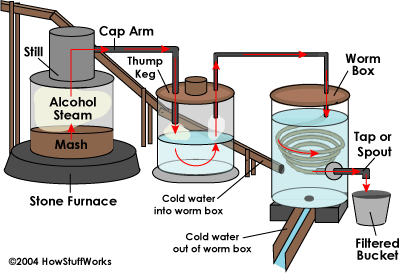
“How Moonshine Works – Walton’s Distillery” from www.waltonsdistillery.com and used with no modifications.
When you rush your moonshine distillation, you’re playing with fire—literally and figuratively. Running your still too hot creates a rapid vapor flow that doesn’t allow proper separation of different alcohols. This isn’t just about getting a lower quality product; it’s about potentially including methanol and other toxic compounds in your final collection. These substances can cause serious health problems ranging from blindness to death in extreme cases.
Historical “bathtub gin” horror stories weren’t just prohibition-era myths—they were often the result of improperly distilled spirits rushed to market. Modern home distillers need to understand that proper technique isn’t optional; it’s essential for creating a product that’s safe to drink.
- Increased methanol content in final product
- Higher levels of fusel oils causing intense hangovers
- Poor flavor development and harsh taste profiles
- Reduced overall yield of usable spirits
- Potential equipment hazards from pressure buildup
Why Distillation Speed Matters for Your Moonshine

Distillation is fundamentally a separation process based on different boiling points of various compounds. Ethanol (the good alcohol) boils at approximately 173°F (78.4°C), while methanol boils at a lower temperature of 148°F (64.7°C). When you run your still slowly and carefully monitor temperatures, you can effectively separate these different alcohols, discarding the dangerous components and collecting only the desirable ones.
Fast distillation disrupts this delicate separation process. When vapor rises too quickly through your still, it creates turbulence that carries unwanted compounds along with the ethanol. This is like trying to separate egg whites from yolks by violently shaking the egg—you’ll end up with everything mixed together.
“Running a still ‘hot’ or ‘cool’ has an impact on the flavor. If you run it too hot (fast flow rate for its size) you get a harsher spirit. The recommended 2-3 drops per second gives you the control needed for proper separation.”
Poor Alcohol Separation Leads to Contamination
When you rush the distillation process, the careful separation of alcohols by their boiling points becomes compromised. Different alcohols and compounds vaporize at different temperatures, and proper separation requires time and patience. Ethanol, the alcohol we want in our final product, boils at 173°F (78.4°C), but methanol (which can cause blindness) boils at 148°F (64.7°C).
A rapid distillation rate creates turbulence in the vapor path, carrying heavier compounds that would normally remain in the boiler. This is particularly dangerous during the critical foreshots and heads portions of your run. Without proper separation, these harmful compounds contaminate what should be your clean hearts cut.
Temperature Control Issues When Running Too Fast
Temperature stability is the backbone of successful distillation, and rushing creates significant control problems. When you apply too much heat to speed up production, you create temperature spikes that are difficult to manage. Your still requires a delicate balance—enough heat to maintain vaporization but not so much that separation becomes impossible. For those interested in the art of moonshining, exploring various moonshining traditions can provide valuable insights into maintaining this delicate balance.
Many newcomers make the mistake of cranking up the heat when impatience sets in, only to discover their thermometer readings jumping erratically. This temperature roller coaster makes it nearly impossible to make accurate cuts between the different fractions of your run. Without stable, predictable temperature readings, you’re essentially distilling blindfolded.

Impact on Flavor Profile and Overall Quality
Beyond safety concerns, rushing your distillation severely impacts the taste of your final product. The complex flavor compounds that give moonshine its character develop properly only during a slow, controlled distillation process. When rushing, many of these delicate flavor compounds are either destroyed by excessive heat or improperly separated from unwanted elements.
Expert distillers can immediately taste the difference between properly distilled spirits and those that were rushed. The rushed product typically has a harsh, burning sensation that overwhelms any desirable flavors. It often carries a chemical sharpness that no amount of aging or filtering can remove. Quality moonshine should be smooth with distinct character, not a painful experience.
Many new distillers mistakenly believe they can compensate for poor distillation techniques with filtering or flavoring additions. Unfortunately, once these off-flavors are integrated into your distillate, they’re nearly impossible to remove completely. The only real solution is prevention through proper distillation speeds.
5 Warning Signs You’re Running Your Still Too Quickly

“Order Warning Signs for Workplace Safety” from www.vkf-renzel.com and used with no modifications.
Recognizing when your distillation is moving too fast can save your batch from disaster. Look for these telltale signs that indicate you need to dial back your heat and slow things down. Each of these warnings represents a different aspect of the distillation process that’s being compromised by excessive speed. For those interested in improving the quality of their moonshine, understanding how to make moonshine taste smooth can also be beneficial.
1. Inconsistent Distillate Temperature
When your still is running too fast, the thermometer reading at your collection point will fluctuate wildly instead of showing the gradual increase you should expect. These temperature swings indicate that you’re getting mixed alcohols rather than the clean, sequential separation you want. A properly running still shows predictable, gradual temperature increases as you move through the different stages of distillation.
If your temperature jumps more than 2-3 degrees in a short period, you’re likely applying too much heat. This volatility makes it nearly impossible to make proper cuts between foreshots, heads, hearts, and tails, leading to a contaminated final product.
2. Cloudy or Milky Appearance in Your Collection
Quality distillate should be crystal clear, especially during the hearts portion of your run. When your distillate appears cloudy or has a milky appearance, it typically indicates that water vapor and oils are being carried over with your alcohol. This happens when the vapor rises too quickly through your column without proper reflux or when excessive heat creates turbulence in your still. For more on achieving a clear and smooth finish, check out how to make moonshine taste smooth.
This cloudiness isn’t just an aesthetic issue—it’s a reliable indicator that your separation is poor and your distillate likely contains unwanted compounds. Properly distilled spirits should be transparent and bright, particularly during the hearts cut.
3. Strong Chemical Smell in Early Collections
Your nose is one of your most valuable tools during distillation. The early portions of your run should have distinct aromas that help you identify when to make your cuts. Foreshots typically have a strong, solvent-like smell, while heads have a sharp, acetone-like aroma before transitioning to the sweeter, cleaner smell of hearts. To ensure a smooth final product, learn how to make moonshine taste smooth.
When running too fast, these distinct aromas blend together, making it difficult to determine where one fraction ends and another begins. If your distillate continues to have harsh chemical notes well into what should be your hearts collection, you’re likely running too hot and fast, failing to properly separate the different components.

4. Poor Separation Between Foreshots, Heads, and Hearts
Proper distillation creates distinct transitions between the different fractions of your run. You should be able to notice clear changes in aroma, taste, and mouthfeel as you move from foreshots to heads to hearts. When your still runs too quickly, these transitions become blurred or happen too rapidly to make proper cuts. To understand more about the distillation process, you can explore why moonshine has to sit before it’s ready.
If you find that your collection seems to jump from foreshots-like characteristics directly to what should be hearts without the intermediate heads section, your distillation is moving too quickly. This compressed timeline doesn’t allow for proper separation of the different alcohols and compounds.
5. Excessive Fluctuation in Alcohol Proof
During a properly paced distillation run, the proof (alcohol percentage) of your collection should follow a predictable curve—starting high during heads, reaching peak strength during early hearts, then gradually declining as you move into tails. When measuring with an alcoholmeter or hydrometer, these changes should be gradual and consistent. For more insights on the process, check out this article on moonshining traditions.
Erratic proof readings indicate that your still is running too fast, causing inconsistent vaporization and collection. These fluctuations make it nearly impossible to make accurate cuts, resulting in a final product with unpredictable strength and character. Consistent proof readings throughout each section of your run are a hallmark of proper distillation technique.
The Ideal Drip Rate for Quality Moonshine
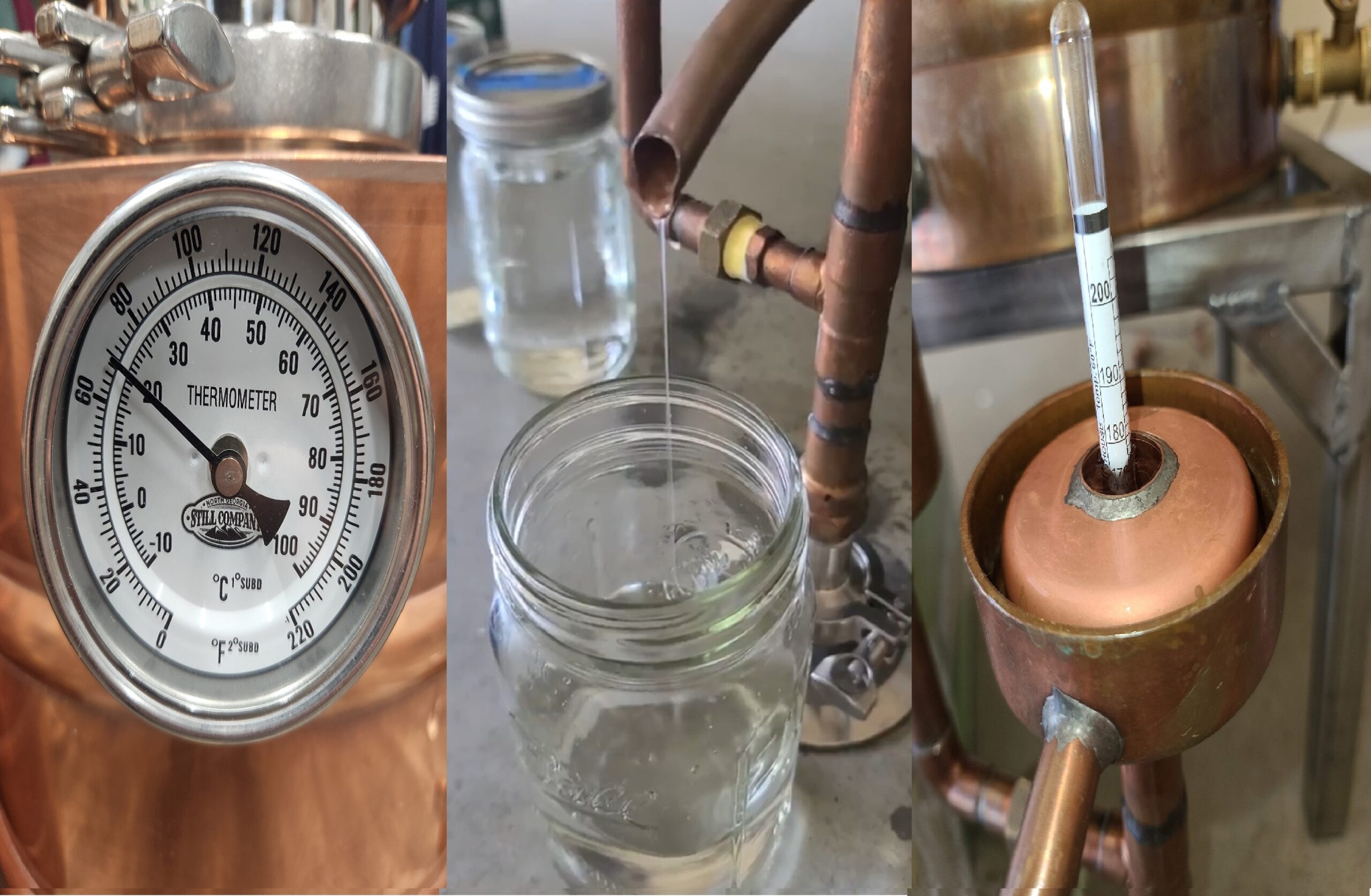
“Temperature, Flow/Drip Rate, Or Proof …” from www.ngstillco.com and used with no modifications.
Finding the perfect distillation rate is critical for producing safe, flavorful spirits. While larger commercial operations measure flow rates in gallons per minute, home distillers should focus on achieving the ideal drip rate—typically 2-3 drops per second for most home setups. This pace allows for proper separation while still maintaining an efficient process.
Why Methanol Separation Requires Patience
Methanol is one of the most dangerous compounds produced during fermentation, and its proper removal requires a methodical approach. This toxic alcohol boils at 148°F (64.7°C), significantly lower than ethanol’s 173°F (78.4°C) boiling point. This temperature difference is what allows distillers to separate and discard methanol during the foreshots stage—but only if the process isn’t rushed. When you run your still too quickly, the temperature rises so rapidly that the methanol separation window becomes compressed or missed entirely.
Think of distillation as a marathon, not a sprint. The time you invest in carefully managing the early stages of your run pays dividends in safety. During proper distillation, you’ll discard the first 150ml per 5 gallons of wash as foreshots, capturing much of the methanol. But this separation relies on temperature control that’s only possible with a slow, steady heating profile. Rushing through this critical phase is simply not worth the risk to yourself or anyone who might consume your spirits.
Expert Advice for First-Time Distillers
“How to Open a Distillery – Spirits Beacon” from spiritsbeacon.com and used with no modifications.
- Always discard the first 5-10% of your distillation run (foreshots)
- Never leave your still unattended during operation
- Use proper cooling water management to maintain consistent condensation
- Measure your collection in small, individual jars to make proper cuts easier
- Label everything meticulously—memory is unreliable during long distillation sessions
First-time distillers often approach moonshine making with a mixture of excitement and trepidation. This balanced perspective is actually healthy—making spirits at home should be approached with both enthusiasm and respect for the process. Remember that every established distiller was once in your position, learning through careful observation and gradual refinement of their technique.
Your first few runs should prioritize safety and learning over yield or efficiency. It’s far better to discard too much of your distillate than too little when you’re uncertain about the cuts. Conservative cuts might mean less final product, but they ensure what you do keep is both safe and pleasant to drink. As you gain experience, you’ll refine your cutting technique to maximize your yield without compromising quality.
One of the most valuable tools for a new distiller is a mentor with experience. Whether this is an experienced friend or an online community of distillers, having knowledgeable guidance can help you avoid common pitfalls. Don’t be afraid to ask questions and share your results (minus specific recipes in public forums if distilling isn’t legal in your area).
Keep in mind that distillation is both an art and a science. While understanding the technical aspects is important, developing a feel for your particular still and process is equally valuable. No two stills behave exactly alike, and learning the quirks of your equipment is part of the journey.
Start Slow and Take Detailed Notes
Comprehensive documentation is your best friend in developing distilling expertise. Record everything during your runs: heating adjustments, temperature changes, times, aromas, tastes (once safe to sample), appearance changes, and volume collected at different stages. These notes become invaluable as you compare different batches and refine your technique. Many expert distillers can trace their improvement directly to the discipline of detailed note-taking, allowing them to replicate successes and avoid repeating mistakes.
Safety Precautions That Cannot Be Skipped
Distillation involves flammable vapors and high heat, creating inherent risks that demand respect. Never operate your still near open flames, ensure proper ventilation to prevent alcohol vapor buildup, and keep a fire extinguisher rated for alcohol fires nearby. Use food-grade materials throughout your setup—no lead solder, questionable plastics, or unknown metal alloys should contact your wash or distillate. These safety measures aren’t optional extras; they’re fundamental requirements.
Beyond equipment safety, the consumption safety of your product depends on proper technique. Always perform the “sniff test” on your distillate—if it smells like chemicals or nail polish remover, it’s not ready to drink. When in doubt, discard suspect portions of your run. No amount of moonshine is worth risking your health or the health of those who might consume it.
Building Your Distilling Intuition Over Time
Distilling intuition isn’t developed overnight—it comes from repeated observation and experience with your particular setup. With each run, you’ll become more attuned to the subtle cues that indicate transitions between fractions: the changing aromas, the appearance of the distillate, the sound of your still, and even the feel of the vapor temperature at different points. This sensory awareness, combined with technical knowledge, creates the instinct that allows master distillers to make perfect cuts almost automatically, knowing precisely when to switch collection jars without consulting thermometers or timers. For more insights, explore moonshining traditions that have shaped this craft over the years.
Fine-Tuning Your Technique for Better Results

“The Ultimate Guide to LLM Fine Tuning …” from www.lakera.ai and used with no modifications.
As your confidence grows, you can begin refining your technique to enhance flavor and efficiency. Try collecting your distillate in smaller jars (4-8 oz) during transition zones between fractions, allowing you to make more precise blending decisions later. This approach gives you the flexibility to include some of the late heads or early tails in your final product if they contain desirable flavor compounds, without compromising overall quality. Some distillers even separate their hearts into early, middle, and late portions, each with distinct character.
Consider experimenting with different heat management approaches, such as gradually reducing your heat input as you transition from foreshots to heads to hearts. This technique, sometimes called “managing the power curve,” can help maintain ideal separation as the composition of your wash changes throughout the run. Remember that any modifications to your process should be done incrementally and documented carefully, allowing you to evaluate their impact on your final product with clarity.
Frequently Asked Questions
After guiding hundreds of new distillers through their first moonshine runs, I’ve found certain questions arise consistently. These FAQs address the most common concerns about distillation speed and technique that might not be covered in basic instructions.
How long should a proper moonshine run take from start to finish?
A proper run for a typical 5-gallon wash in a home-sized still should take between 4-6 hours from the moment you apply heat until you finish collecting tails. Smaller stills might complete the process in 3-4 hours, while larger setups or reflux stills might take 6-8 hours. The hearts portion—where you collect your premium moonshine—should comprise roughly 30-40% of this time. If your entire run takes less than 2-3 hours, you’re almost certainly rushing the process and compromising separation quality.
Can I save time by increasing the heat during certain parts of the run?
While it’s tempting to accelerate certain portions of your run, particularly the initial heating phase, dramatic heat changes generally cause more problems than they solve. The early stages of heating establish the temperature gradient in your still that allows for proper separation. Rushing this foundation leads to poor results throughout the entire run.
That said, experienced distillers sometimes make minor heat adjustments—increasing slightly during foreshots collection, then reducing for precise heads separation, and finding a sweet spot for hearts collection. These adjustments should be subtle—think 5-10% changes in heat input, not dramatic swings—and should only be attempted after you’ve mastered the basics of consistent distillation.
What happens if I accidentally mix the foreshots with my hearts?
If you suspect foreshots have contaminated your hearts collection, the safest approach is to discard the batch. Methanol and other toxic compounds found in foreshots can cause serious health problems, including blindness and even death in sufficient quantities. No amount of filtering, redistilling, or aging will make these compounds safe for consumption.
For minor contamination concerns—such as if you’re uncertain about the precise transition between heads and hearts—you can consider redistilling at a very slow rate with even more conservative cuts. However, when actual foreshots are involved, it’s not worth the risk. Remember the distiller’s mantra: “When in doubt, throw it out.”
If you’re consistently uncertain about your cuts, consider implementing a more systematic approach. Number your collection jars sequentially, make tentative cuts based on temperature and sensory evaluation, but don’t blend anything until you’ve completed the run and can evaluate each fraction with a clear head.
- Never taste foreshots or early heads—evaluation should be by smell only
- Use smaller collection vessels to make more precise cuts
- Label everything immediately—memory is unreliable during long distillation sessions
- Consider using pH strips to help identify the transition to tails (becoming more acidic)

Do different mash recipes require different distillation speeds?
While the fundamental principles of proper distillation apply to all mash types, there are subtle differences in optimal speeds for different recipes. Grain-heavy mashes tend to foam more during distillation and may require slightly slower heating to prevent boilover or vapor path contamination. Fruit mashes often contain more pectin and can benefit from particularly careful temperature control during the heads stage to preserve delicate aromatics. For more insights on traditional methods, explore moonshining traditions.
Sugar washes (the simplest mashes) are generally more forgiving of slight variations in distillation speed, but still require proper technique for quality results. Regardless of your mash type, starting with a conservative, slow approach and adjusting based on results is the wisest strategy. Your specific still design, cooling efficiency, and even the ambient temperature in your distilling space will influence the ideal rate more than minor differences in mash composition.
Is there any way to fix moonshine that was run too fast?
The honest answer is that there’s no perfect fix for improperly distilled spirits. The fundamental separation issues created by running too fast create problems that are difficult to remedy after the fact. Redistilling might improve the product somewhat but won’t completely resolve flavor issues and comes with significant yield loss. Activated carbon filtering can remove some harshness but also strips away desirable flavors.
The most practical approach is to use over-distilled spirits for purposes where purity is less critical—as a base for infusions, for making extracts, or for cleaning purposes. The best solution, however, is prevention: take the time to run your still properly from the beginning, and you’ll avoid the disappointment of compromised spirits altogether.