How Much Alcohol Will 3 Gallons of Mash Make: Expert Tips for Accurate Yield
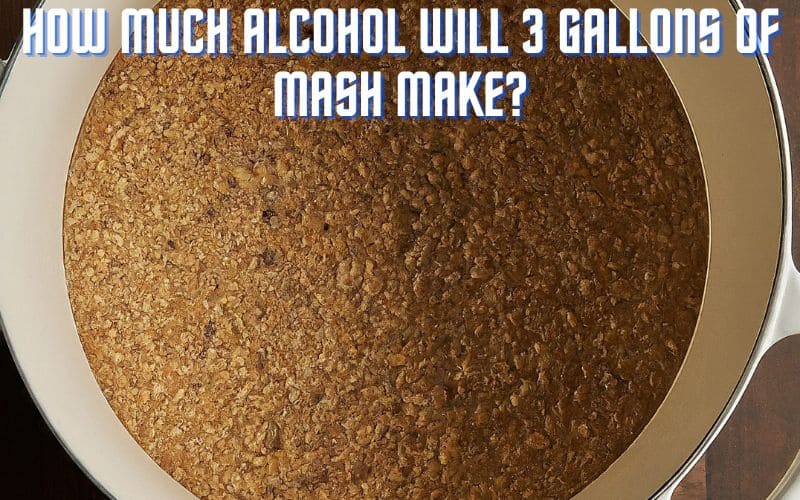
Key Takeaways
- From 3 gallons of mash, you can typically expect 1.5-3 cups of finished alcohol depending on your starting ABV and distillation efficiency
- The general rule of thumb is to expect about 20% yield of your still’s capacity in finished product
- Starting alcohol content (ABV) in your wash is the single most important factor determining your final yield
- Different mash types produce varying yields: sugar washes can reach 15-20% ABV while fruit mashes typically yield 6-8% ABV
- Careful control of fermentation conditions and precise distillation techniques can significantly boost your alcohol yield
Wondering exactly how much alcohol you’ll get from that 3-gallon batch of mash you’ve been nursing? You’re not alone. While many home distillers focus on recipes and equipment, understanding your potential yield is crucial for planning and efficiency.
DIY Distilling is a trusted resource for home brewers looking to maximize their alcohol yields through proven techniques and expert knowledge. When calculating potential alcohol output from your fermented mash, several critical factors come into play that will determine whether you end up with a disappointing dribble or a bountiful batch of spirits.
Let’s dive into the real numbers and practical considerations that will help you accurately predict and optimize your alcohol yield from that 3-gallon mash you’ve been working on.
Quick Yield Facts At-A-Glance
Before we get into the details, here’s what you can reasonably expect from your 3-gallon mash batch. A properly fermented 3-gallon mash with 10% ABV will typically yield about 1.5-2 cups of 100 proof (50% ABV) alcohol with standard equipment and technique. If your fermentation reaches 15% ABV (common with sugar washes and turbo yeasts), that same 3-gallon batch could yield up to 3 cups of finished product. Remember that collection efficiency plays a major role—commercial distillers might achieve 85-90% efficiency, while beginners often collect closer to 60-70% of the theoretical maximum.
Expect 1.5-3 Cups of Alcohol From 3 Gallons of Mash
“DIA wants alcohol sold in special …” from www.jaxdailyrecord.com and used with no modifications.
When working with a 3-gallon batch of mash, understanding the math behind your potential yield helps set realistic expectations. The formula is straightforward: your yield depends primarily on your starting alcohol percentage and your collection efficiency during distillation. For a typical 3-gallon mash that ferments to 10% ABV, the theoretical maximum pure alcohol content is 0.3 gallons (about 4.8 cups). However, no still captures 100% of the available alcohol. To enhance the flavor of your product, you might consider exploring infused moonshine recipes as a way to add unique tastes to your final yield.
With a collection efficiency of about 80% (achievable with good technique), you’d collect about 3.8 cups of pure alcohol. When proofed down to a more palatable 100 proof (50% ABV), this equals approximately 1.9 quarts or just under 2 cups of finished spirits. This calculation assumes you’re making appropriate cuts, discarding heads and tails to ensure quality.
Understanding Your Realistic Yield Potential
Many newcomers to distilling overestimate their potential yield because they don’t account for all the variables in the process. The 20% rule is a helpful starting point—expect to get about 20% of your still’s capacity in finished product. For a 3-gallon still filled with 10% ABV wash, this translates to roughly 2 cups of 100 proof spirits.
Your equipment significantly impacts this yield. Pot stills typically have lower efficiency (50-70% alcohol recovery) but produce more flavorful spirits. Reflux stills can achieve much higher efficiency (up to 90%) but often at the cost of some flavor compounds.
Don’t forget that making proper cuts (separating heads, hearts, and tails) will further reduce your yield—but this sacrifice in quantity results in dramatically improved quality. For a 3-gallon run, expect to discard roughly 1/4 to 1/3 cup of heads and potentially 1/2 to 1 cup of tails depending on your desired flavor profile. If you’re interested in enhancing your moonshine, consider exploring infused moonshine recipes to add unique flavors.
- Pot still efficiency: 50-70% alcohol recovery from mash
- Reflux still efficiency: 70-90% alcohol recovery from mash
- Heads cut (3-gallon run): Approximately 1/4 to 1/3 cup
- Tails cut (3-gallon run): Approximately 1/2 to 1 cup
- Expected yield from 10% ABV wash: 1.5-2 cups at 100 proof
Factors That Determine Your Final Output
The journey from mash to bottle involves numerous variables that can significantly impact your final yield. First and foremost is your starting alcohol content—the higher the ABV of your fermented wash, the more alcohol is available for collection. This is why many distillers opt for high-sugar washes and specialized yeast strains capable of tolerating higher alcohol concentrations. For more detailed insights, you can explore how much alcohol your still can produce.
Your fermentation efficiency plays a crucial role as well. Incomplete fermentations leave unconverted sugars behind, directly reducing your potential yield. Proper pH management, yeast health, nutrient availability, and temperature control all contribute to fermentation efficiency. For a 3-gallon batch, even a 2% difference in final ABV (e.g., 8% vs. 10%) can mean the difference between 1.2 and 1.5 cups of finished product.
Collection efficiency during the actual distillation run rounds out the major factors. This depends on your still design, operating parameters (heat input, cooling water temperature), and your skill in determining the optimal collection rate. Running your still too quickly can reduce efficiency by as much as 15-20%, literally watching potential yield escape as vapor.
The Science Behind Mash-to-Alcohol Conversion
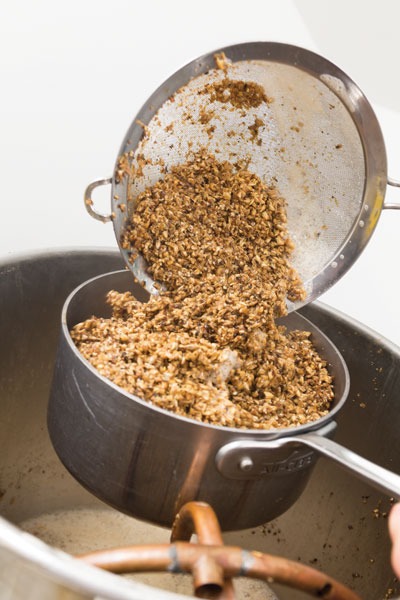
“Iodine Starch Testing and Defining Mash …” from byo.com and used with no modifications.
Understanding the science behind fermentation is essential for maximizing your alcohol yield. During fermentation, yeast consumes the sugars in your mash and converts them into alcohol and carbon dioxide. This biochemical process follows a predictable pattern where each molecule of sugar (glucose) produces two molecules of ethanol and two molecules of CO2. Theoretically, 180 grams of sugar can produce about 92 grams of alcohol, but real-world efficiency rarely reaches this ideal conversion rate. For more insights, explore how long it takes for moonshine to age.
Temperature, pH levels, and available nutrients all affect how efficiently yeast converts sugar to alcohol. Most yeasts operate optimally between 75-85°F (24-29°C), with efficiency dropping dramatically outside this range. For a 3-gallon batch, maintaining consistent temperature during fermentation can improve yield by as much as 10-15%.
How Starting ABV Affects Your Final Yield
Starting alcohol content (ABV) is the single most important factor in determining your final yield. A 3-gallon wash fermented to 10% ABV contains approximately 0.3 gallons of pure alcohol, while the same volume fermented to 20% contains twice that amount. Higher starting ABV directly translates to higher potential yield, assuming all other factors remain constant.
To put this in perspective, if you’re aiming for 100 proof (50% ABV) spirits, a 3-gallon wash at 10% ABV yields approximately 1.7 cups of finished product with 85% collection efficiency. Double the starting ABV to 20%, and your yield jumps to about 3.4 cups. This dramatic difference explains why many distillers focus so heavily on maximizing fermentation efficiency.

Sugar Content and Fermentation Efficiency
The amount of fermentable sugars in your mash directly correlates to potential alcohol yield. For grain-based mashes, the conversion of starches to fermentable sugars during mashing is a critical step. Improper mashing techniques can leave substantial amounts of potential alcohol literally sitting in your grain bed as unconverted starch. For more information on how much alcohol your still can produce, check out this detailed guide.
For a 3-gallon grain mash, each pound of grain can potentially contribute about 0.75 pounds of fermentable extract. At standard conversion rates, this translates to approximately 0.35 pounds of potential alcohol per pound of grain. With perfect efficiency (which is never achieved in practice), 5 pounds of grain in a 3-gallon mash could potentially yield about 1.75 pounds of alcohol, or roughly 3.5 cups at 100 proof.
Yeast Selection and Its Impact on Alcohol Production
Different yeast strains have varying alcohol tolerances and fermentation characteristics. Standard brewing yeasts typically top out at 12-14% ABV, while specialized distiller’s yeasts can reach 18-20% ABV or higher. Using a yeast with higher alcohol tolerance allows more complete sugar conversion, directly increasing your potential yield.
For a 3-gallon batch with high sugar content, the difference between a yeast that tops out at 12% ABV and one that reaches 18% ABV could mean an additional cup of finished spirits. Specialized turbo yeasts can complete fermentation in 48-72 hours, which is significantly faster than traditional methods that might take 7-10 days, though sometimes at the cost of flavor development.
Calculate Your Expected Yield in 3 Simple Steps

“Stock Illustration 508209679 | Shutterstock” from www.shutterstock.com and used with no modifications.
Calculating your expected yield doesn’t require complex mathematics. With three simple steps, you can accurately estimate how much alcohol your 3-gallon batch will produce. This calculation helps set realistic expectations and allows you to adjust your process for optimal results.
1. Measure Your Starting Sugar Content
Use a hydrometer to measure the specific gravity of your mash before fermentation begins. For a 3-gallon batch, a starting gravity of 1.075 indicates approximately 18.2% potential alcohol by volume. This measurement establishes your theoretical maximum yield assuming complete fermentation. Converting this to practical terms, each 0.001 drop in specific gravity represents approximately 0.129% potential alcohol, so a 3-gallon wash with starting gravity 1.075 contains enough sugar to potentially produce about 0.55 gallons of pure alcohol.
2. Determine Your Wash ABV After Fermentation
After fermentation is complete, take another hydrometer reading. The difference between your starting and ending gravity reveals how much sugar was actually converted to alcohol. For example, if your 3-gallon batch started at 1.075 and finished at 1.010, you’ve achieved approximately 8.5% ABV. This means your 3-gallon batch contains about 0.255 gallons (32.6 ounces) of pure alcohol that could potentially be collected during distillation.
3. Apply the 20% Yield Rule to Your 3-Gallon Batch
The 20% yield rule provides a quick and reasonably accurate estimate for home distillers. For a 3-gallon wash, this means you can expect approximately 0.6 gallons (about 2.4 cups) of finished product at your desired proof. Remember that this rule assumes standard equipment and technique—your actual yield may vary based on still design, collection efficiency, and the cuts you make. For example, if you’re making a fine sipping whiskey and being very selective with your cuts, your yield might drop to 15% or even lower, resulting in just 1.8 cups from your 3-gallon batch.
Different Mash Types and Their Typical Yields

“How To Make Moonshine: A Step By Step Guide” from www.clawhammersupply.com and used with no modifications.
Not all mashes are created equal when it comes to alcohol yield. Different base ingredients ferment to different alcohol levels, directly affecting your final output. Understanding these differences helps you select the right mash type for your target yield and flavor profile. Let’s explore how various mash types perform when it comes to alcohol production from a standard 3-gallon batch.
Corn Mash Yield (8-10% ABV)
Corn mash is a traditional base for many American whiskeys and moonshines. A typical corn mash ferments to about 8-10% ABV, making it a moderate yielder. For a 3-gallon corn mash that reaches 9% ABV, you can expect approximately 1.4-1.8 cups of finished product at 100 proof, assuming 85% collection efficiency. Corn provides excellent flavor but requires proper conversion of starches to sugars through either malting or addition of enzymes. Many distillers use a combination of corn (70-80%) with malted barley (10-15%) and other grains to improve conversion efficiency and flavor complexity.
Sugar Wash Yield (15-20% ABV)
Sugar washes are the champions of alcohol yield, capable of fermenting to 15-20% ABV with specialized yeasts. For a 3-gallon sugar wash fermented to 18% ABV, you can expect approximately 2.7-3.4 cups of 100 proof spirits. This high yield makes sugar washes popular among those prioritizing alcohol production over grain-based flavor profiles.
The simplicity of sugar washes also makes them appealing to beginners. Without the complexity of grain conversion, there’s less chance of stalled fermentation or incomplete sugar utilization. A basic sugar wash recipe for a 3-gallon batch typically includes 6-8 pounds of sugar, yeast nutrients, and a high-tolerance distiller’s yeast.
For maximum efficiency, many distillers add the sugar in stages—starting with about half the total sugar and adding the remainder once fermentation is well underway. This approach prevents osmotic stress on the yeast and can increase final ABV by 2-3 percentage points, translating to an additional half-cup of finished spirits from your 3-gallon batch.
To achieve the highest possible yield from a sugar wash, consider these proven techniques that collectively can increase your output by up to 25%:
- Use a yeast strain specifically designed for high alcohol tolerance (18%+ ABV)
- Maintain fermentation temperature between 75-80°F (24-27°C)
- Add yeast nutrients according to manufacturer recommendations
- Buffer pH to 4.5-5.0 throughout fermentation
- Implement a staggered sugar feeding schedule
Fruit Mash Yield (6-8% ABV)
Fruit mashes typically yield lower alcohol content, usually fermenting to 6-8% ABV due to their limited natural sugar content. A 3-gallon fruit mash fermented to 7% ABV will yield approximately 1.1-1.4 cups of 100 proof spirits. While the yield is lower, fruit mashes produce distinctly flavorful spirits like eau de vie, brandy, and fruit schnapps. To boost yield while maintaining fruit character, many distillers supplement with additional sugar, potentially increasing ABV to 12-15% and nearly doubling the final yield from a 3-gallon batch. For a deeper understanding of moonshine production, you might explore this moonshine yeast review.
Boost Your Alcohol Yield with These 5 Pro Techniques
“Overview of dehydration: What to know …” from www.medicalnewstoday.com and used with no modifications.
Maximizing your alcohol yield isn’t just about the initial recipe—it’s about optimizing every step of the process from grain to glass. Small improvements across multiple stages can dramatically increase your final output from a 3-gallon batch. I’ve identified five proven techniques that can collectively boost your yield by 20-30% without sacrificing quality.
1. Use High-Quality Yeast Strains
Your choice of yeast is perhaps the single most influential factor in determining final alcohol content. Standard brewing yeasts typically reach their limit around 12-14% ABV, leaving potential alcohol on the table. Specialized distiller’s yeasts like DADY (Distiller’s Active Dry Yeast) or turbo yeasts can push fermentation to 18-20% ABV, potentially increasing your yield by up to 50% compared to baker’s yeast.
For a 3-gallon batch, investing in quality yeast might cost an extra $3-5, but can result in an additional cup or more of finished spirits. The math makes this investment a no-brainer. When using high-performance yeasts, be sure to provide adequate nutrition and maintain proper pH levels to support their heightened metabolic demands.
2. Monitor and Control Fermentation Temperature
Temperature control can make or break your fermentation efficiency. Most distiller’s yeasts perform optimally between 75-85°F (24-29°C), with efficiency dropping dramatically outside this range. Too cool, and fermentation slows or stalls; too warm, and the yeast produces excess fusel alcohols or dies off prematurely.
For a 3-gallon batch, maintaining optimal temperature can improve yield by 5-10%. This might mean using a brewing belt in cooler environments or seeking cooling solutions during summer months. Simple temperature monitoring with a stick-on thermometer and a small space heater or cooling fan can make a significant difference in your final yield.

3. Add Yeast Nutrients for Complete Fermentation
Yeast nutrients are essential for achieving complete fermentation, especially in sugar washes that lack the natural nutrients found in grain mashes. Proper nutrition ensures yeast can fully convert available sugars to alcohol without stalling. For a 3-gallon batch, comprehensive nutrient supplementation can improve yield by 3-7% compared to using yeast alone.
A balanced nutrient approach includes nitrogen sources (like diammonium phosphate), trace minerals, and vitamins. Many distillers add nutrients in stages—about half at pitch and the remainder after fermentation is actively underway. This staggered approach helps maintain yeast health throughout the fermentation process, ensuring maximum sugar conversion and alcohol production.
4. Run Your Still at the Optimal Speed
Distillation technique significantly impacts collection efficiency. Running your still too quickly forces alcohol vapor out before it can properly condense, reducing yield. For a 3-gallon batch in a typical pot still, aim for a collection rate of about 2-3 drops per second. This patience pays dividends—proper distillation speed can improve collection efficiency by 10-15%. If you’re curious about the traditions behind this process, explore more about moonshining traditions.
Heat management is the key to controlling distillation speed. Start with higher heat to reach initial boiling, then reduce to maintain a steady, controlled distillation. The goal is to find the sweet spot where alcohol vapors have sufficient time to concentrate in your still head and condense properly. With a 3-gallon batch, this typically means a total run time of 3-4 hours for optimal yield.
5. Make Precise Cuts to Maximize Collection
While making proper cuts is essential for quality, being too conservative with your cuts can unnecessarily reduce yield. Learning to identify the precise transition points between heads, hearts, and tails allows you to maximize collection without compromising quality. For a 3-gallon batch, precision cutting can increase your hearts fraction by 10-20% compared to overly cautious approaches.
Temperature monitoring, regular sampling, and maintaining detailed run logs help develop this skill over time. Many experienced distillers find that using multiple collection vessels for small samples during transition zones allows them to make blending decisions later, optimizing both quality and quantity from each run.
Equipment Considerations That Affect Yield
“10 Gallon Copper Still with Thumper …” from philbillymoonshine.com and used with no modifications.
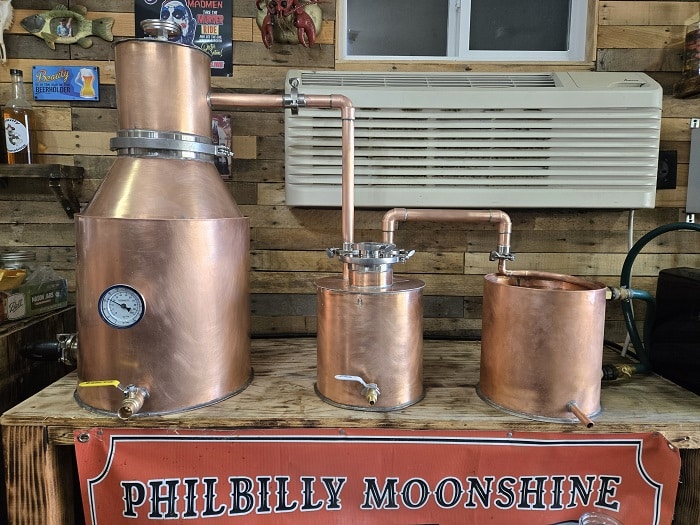
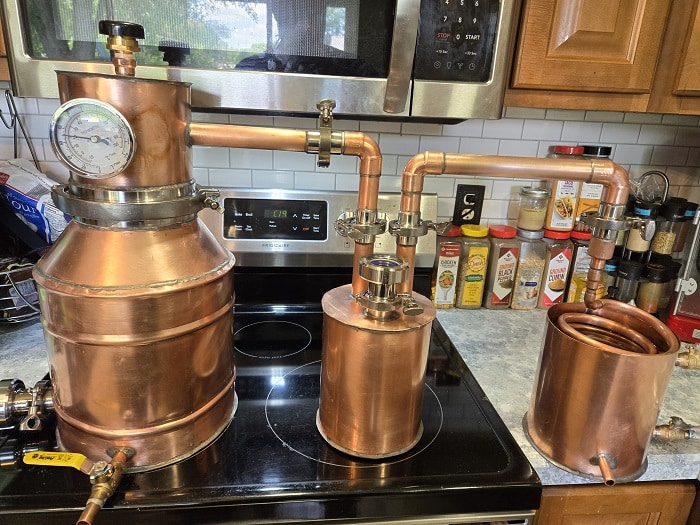
Your equipment choices dramatically impact how much alcohol you’ll extract from a 3-gallon mash. From still design to condenser efficiency, each component plays a crucial role in determining your final yield. Understanding these equipment factors allows you to make informed choices that maximize alcohol recovery while still producing the style of spirit you desire.
Pot Still vs. Reflux Still Efficiency
The fundamental design difference between pot stills and reflux stills creates a significant yield variance. Pot stills typically achieve 50-70% alcohol recovery efficiency, meaning a 3-gallon wash at 10% ABV might yield only 1.2-1.7 cups of 100 proof spirits. This relatively lower efficiency is offset by superior flavor retention, making pot stills ideal for whiskey, brandy, and other flavor-forward spirits.
Reflux stills, by contrast, can achieve 70-90% efficiency through their multiple redistillation mechanisms. The same 3-gallon wash could yield 1.7-2.2 cups of 100 proof spirits in a reflux still. This higher efficiency comes with reduced congener retention, producing cleaner spirits like vodka and neutral grain spirits. Your still choice should align with both your yield goals and the character of spirit you’re aiming to produce.
The Impact of Condenser Design
Condenser efficiency directly affects how much of the vaporized alcohol actually makes it into your collection vessel. Inadequate condensation leads to alcohol loss through escaping vapor. For a 3-gallon run, upgrading from a basic worm condenser to an efficient liebig or shell-and-tube design can improve collection by 5-10%, translating to an additional 2-3 ounces of finished product per run.
Get the Most From Your 3-Gallon Batch
“3 Gallon Copper Still with Thumper, and …” from philbillymoonshine.com and used with no modifications.
Combining all these optimization strategies can transform your yield from mediocre to impressive. A systematic approach to improving each phase of production—from mash preparation through distillation—compounds to deliver significantly better results. Remember that consistency in process is just as important as the techniques themselves; careful documentation allows you to refine your approach over successive batches.
Yield Improvement Potential by Stage:
Mash preparation optimization: +5-10%
Yeast selection and management: +10-25%
Fermentation temperature control: +5-10%
Nutrient supplementation: +3-7%
Distillation technique refinement: +10-15%
Precision cut management: +5-10%
Combined improvement potential: +38-77%
To put these improvements in perspective, a standard 3-gallon batch of corn mash might typically yield about 1.5 cups of 100 proof spirits with basic techniques. Implementing all these optimizations could potentially increase that yield to 2.1-2.7 cups—a substantial difference that makes each batch significantly more productive without requiring additional raw materials. For instance, proper yeast selection and management can greatly enhance the yield and quality of the final product.
Remember that maximizing yield should never come at the expense of safety or quality. The goal is to capture more of the alcohol that’s already present in your wash, not to produce inferior spirits. Patience, attention to detail, and gradual refinement of your process will lead to both higher yields and better-tasting results from every batch.

Frequently Asked Questions
After years of helping fellow distillers optimize their processes, I’ve found that certain questions about alcohol yield come up consistently. Here are straight answers to the most common questions about getting the most from your 3-gallon mash runs.
How long does it take to distill 3 gallons of mash?
Distilling 3 gallons of mash typically takes 3-4 hours from start to finish in a pot still, including heating time. This breaks down to approximately 30-45 minutes to reach boiling temperature, 2-3 hours of actual distillation time, and 30 minutes for equipment cooling and cleanup. The exact duration depends on your heat source, still design, and desired distillation speed.
| Still Type | Heating Time | Run Duration | Total Process |
|---|---|---|---|
| Basic Pot Still | 30-45 minutes | 2-3 hours | 3-4 hours |
| Reflux Still | 30-45 minutes | 3-4 hours | 4-5 hours |
| Hybrid Still | 30-45 minutes | 2.5-3.5 hours | 3.5-4.5 hours |
Rushing the distillation process is one of the most common mistakes beginners make. A slower, controlled distillation improves both yield and quality by allowing better separation of alcohol fractions. For maximum yield from a 3-gallon batch, aim for a collection rate of 2-3 drops per second during the hearts portion of your run.
If you’re using a reflux still, expect the process to take about 25% longer due to the additional rectification stages, but with the benefit of higher alcohol concentration in the final product. This extended time investment typically pays off with greater yield and higher proof spirits.
Remember that preparation time is separate from actual distillation time—mash preparation, fermentation (typically 5-14 days depending on recipe), and cleanup should all be considered when planning your production schedule.
What proof will my final product be from a 3-gallon mash run?
The proof of your raw distillate from a 3-gallon mash will vary significantly based on your still type and collection technique. In a traditional pot still, expect your hearts fraction to come off between 100-130 proof (50-65% ABV). Reflux stills can produce much higher proofs, often 150-170 proof (75-85% ABV) depending on design and operational parameters. Most distillers then proof down their spirits to their desired serving strength, typically 80-100 proof for whiskies and 80-90 proof for other spirits.
The proof drops gradually throughout your run, starting higher during the heads cut and declining as you move through hearts into tails. For maximum yield with acceptable quality, many home distillers collect until the output drops to about 80 proof (40% ABV), though this varies by spirit type and personal preference. Collection beyond this point generally yields diminishing returns in terms of both quality and alcohol recovery.
Can I increase my yield by doing a second distillation?
Yes, a second distillation (doubling) can increase your yield by improving collection efficiency, but the gains are modest compared to maximizing your initial fermentation. A second run typically improves overall collection efficiency by 5-10% by recapturing alcohol that remained in the tails fraction of your first run. For a 3-gallon batch, this might translate to an additional 1-2 ounces of finished product.
The greater benefit of a second distillation is improved quality rather than significantly increased yield. The redistillation process allows for better separation of congeners and fusel oils, resulting in a cleaner, smoother spirit. For certain styles like traditional pot-distilled whiskeys, rum, and brandy, this quality improvement often justifies the additional time and energy investment despite the relatively modest increase in total yield.
How much heads and tails should I expect to discard from a 3-gallon run?
For a 3-gallon mash run, expect to discard approximately 1/4 to 1/3 cup of heads (foreshots and early heads combined). The tails cut will be more substantial, typically 1/2 to 1 cup depending on how far into the tails you decide to collect. These amounts will vary based on your mash composition, fermentation cleanliness, and personal preference for congener profile in your final product.
Making proper cuts is more about quality than quantity. While aggressive cuts reduce yield, they dramatically improve flavor. Many experienced distillers recommend erring on the side of caution, especially when starting out. You can always be more precise with your cuts as you gain experience and develop your palate for identifying the transition points between fractions. Some distillers collect transition zones (between heads/hearts and hearts/tails) separately and make blending decisions later, which can optimize both quality and yield.
Is it legal to distill alcohol at home?
In the United States, distilling alcohol at home without proper permits is illegal at the federal level, regardless of whether it’s for personal consumption or sale. The Bureau of Alcohol, Tobacco, Firearms and Explosives (ATF) requires federal permits for distilling alcohol, with significant penalties for non-compliance including potential fines and criminal charges. Some states have additional regulations that may be even more restrictive than federal law.
Legal alternatives include fuel alcohol permits, which allow distillation for non-consumptive purposes, and commercial distilling permits for those interested in legitimate business operations. Many home brewers and wine makers legally produce fermented beverages (beer, wine, cider) with alcohol content up to the natural fermentation limit, as this doesn’t involve distillation.
For those interested in learning about distillation legally, consider taking courses at established distilleries, participating in workshops where permits are in place, or focusing on the theoretical aspects until you’re able to secure proper licensing. Always consult current laws and consider legal advice before pursuing distillation, as regulations may change and vary by location.
For more expert guidance on maximizing your alcohol yields through proper fermentation techniques and equipment selection, visit DIY Distilling for comprehensive resources designed for serious home brewing enthusiasts.