Moonshining Traditions: Unveiling The Hidden History
Article-at-a-Glance
- Moonshine production began as a necessity for early American settlers, particularly Scots-Irish immigrants who brought their distilling traditions to the Appalachian region.
- The term “moonshine” originated from the practice of distilling at night by moonlight to avoid detection by tax collectors and law enforcement.
- Prohibition (1920-1933) created a golden age for moonshiners, leading to sophisticated distribution networks and the birth of NASCAR through bootlegger’s souped-up cars.
- Traditional moonshine production methods involved copper stills, careful fermentation, and secret techniques passed down through generations.
- Today’s craft distilleries are reviving historical moonshining traditions while following modern safety and legal standards.
Deep in the hollows of Appalachia, hidden among mist-shrouded mountains and beneath the protective canopy of ancient forests, a distinctly American tradition took root and flourished for centuries. Moonshine – the unaged, high-proof spirit produced in secret – represents more than just an alcoholic beverage; it embodies a heritage of independence, resourcefulness, and resistance against authority. The story of moonshine is inextricably woven into the fabric of American history, reflecting economic necessity, cultural identity, and a fierce spirit of self-reliance that has characterized rural communities across the country.
The Mountain Moonshine Company, a modern craft distillery preserving these ancient techniques while adhering to today’s safety standards, continues the tradition of America’s original spirit makers. Their artisanal approach honors the centuries of knowledge that went into creating what was once America’s most controversial beverage, now bringing these flavors to legal markets worldwide.
The Secret World of Moonshine: America’s Underground Spirit

“Mystery of a Country Moonshine Bunker …” from www.nytimes.com and used with no modifications.
Moonshine has always existed in the shadows of American history, simultaneously celebrated and vilified. At its core, moonshine is simply unaged whiskey produced outside government oversight. What sets it apart from legal spirits isn’t necessarily its ingredients or production methods, but rather the absence of taxation and regulation. Traditional moonshine was typically made from corn, though resourceful distillers used whatever fermentable ingredients were available – from potatoes and apples to peaches and sugar.
What Makes Moonshine Different From Legal Spirits
Unlike commercial whiskeys that spend years aging in charred oak barrels to develop color and flavor complexity, moonshine goes straight from still to jar without the transformation that comes with aging. This results in a clear spirit that showcases the raw character of its ingredients. The proof of traditional moonshine typically ranged from 100 to 125 (50-62.5% alcohol), significantly higher than commercial spirits. This potency wasn’t just for effect – higher alcohol content meant the product could be diluted by middlemen while still delivering the kick customers expected, maximizing profits along the distribution chain.
Why It Earned the Name “Moonshine”
The evocative term “moonshine” originated from the necessity of working under cover of darkness. Early distillers operated their stills at night when the smoke from their fires would be less visible against the dark sky. The moonlight became their working companion as they conducted their secretive business, giving rise to the poetic name that would stick for centuries. Other colorful terms like “white lightning,” “mountain dew,” and “hooch” captured both the appearance and the powerful effect of this untaxed spirit.
“We always worked in the dark of night, with just the moon to light our way. You’d keep one eye on your still and one eye on the ridge line, watching for revenue men. That’s why they called it moonshining – we worked by the light of the moon.” – Anonymous Appalachian moonshiner, 1930s
Deep Mountain Roots: The Origins of American Moonshining

“Southern Bootleggers …” from historycollection.com and used with no modifications.
The story of American moonshine begins not in the mountains of Appalachia, but across the Atlantic in the rural communities of Scotland, Ireland, and Northern England. When waves of Scots-Irish immigrants arrived in the American colonies in the 18th century, they brought with them not only their cultural traditions but also their centuries-old knowledge of distilling grain into potent spirits. These settlers, seeking affordable land and freedom from religious persecution, found the isolated valleys and hollows of Appalachia perfectly suited to both their independent lifestyle and their distilling practices.
Scots-Irish Immigrants and Their Distilling Knowledge
The Scots-Irish settlers who populated the Appalachian region brought with them generations of distilling expertise. In the British Isles, whiskey production was a normal part of agricultural life – a practical way to preserve excess grain by transforming it into a valuable, shelf-stable product. These early immigrants found the Appalachian region remarkably similar to their homeland, with abundant fresh water, fertile soil for growing grain, and dense forests providing ample fuel and cover. Their distilling knowledge wasn’t just cultural heritage; it was an essential survival skill in a cash-poor frontier economy.
How Early American Farmers Turned Surplus Grain Into Profit
For early American farmers, converting grain into whiskey solved a critical economic problem. Transporting bulky corn or rye over mountainous terrain to distant markets was impractical and unprofitable. A horse could carry only four bushels of grain over the mountains, but those same bushels, when distilled, became sixteen gallons of whiskey – a far more valuable and transportable commodity. A single gallon of whiskey might be worth a week’s wages, making distillation not just convenient but economically essential for rural farmers. Whiskey also served as a stable form of currency in regions where actual money was scarce, used to pay for goods, services, and even taxes.

The Whiskey Rebellion: When Taxation Sparked Resistance
The first great clash between moonshiners and government authority came shortly after American independence, when Treasury Secretary Alexander Hamilton proposed an excise tax on distilled spirits in 1791. This tax disproportionately affected small-scale, rural distillers who lacked the economies of scale enjoyed by larger commercial operations. The resulting “Whiskey Rebellion” saw armed resistance across the frontier, particularly in western Pennsylvania, forcing President Washington to lead federal troops to quell the uprising. While the rebellion was suppressed, it established a pattern that would repeat throughout American history: government taxation of spirits met with fierce resistance from independent distillers who viewed such taxes as an infringement on their liberty and livelihood. For more insights, explore the difference between spirits and moonshine.
- The Whiskey Tax of 1791 required small distillers to pay between 7 and 18 cents per gallon, an enormous sum at the time
- Western Pennsylvania became the epicenter of resistance, with tax collectors tarred and feathered
- President Washington assembled a militia force of nearly 13,000 men to suppress the rebellion
- Though the rebellion was defeated, many distillers simply moved deeper into the mountains to continue production
- This conflict established the tradition of moonshining as an act of political and economic resistance
The Whiskey Rebellion may have been quelled, but the spirit of resistance it embodied never truly died. Instead, it retreated deeper into the mountains, where successive generations would continue the tradition of making spirits beyond government control. This tension between taxation and resistance would define moonshine culture for centuries to come, reaching its zenith during the Prohibition era of the early 20th century.
Prohibition: The Golden Age of Moonshining
“Exploding moonshine: This time its …” from www.cnn.com and used with no modifications.
While moonshining was well-established in American culture by the early 20th century, it was the passage of the Eighteenth Amendment in 1919 and the subsequent Volstead Act that ushered in the golden age of illicit distilling. Prohibition, intended to address social problems associated with alcohol consumption, instead created an unprecedented demand for illegal spirits. As legitimate distilleries shuttered their operations, moonshiners stepped into the void, dramatically scaling up production to meet the nation’s undiminished thirst.
How the 18th Amendment Created a Bootlegging Boom
The national ban on alcohol production and sale transformed moonshining from a regional tradition into a massive underground industry. Rural distillers who had been making small batches for local consumption suddenly found themselves supplying urban markets hundreds of miles away. The economics were irresistible – a gallon of moonshine that cost perhaps $2 to produce could sell for $20 or more in cities like Chicago or New York. This explosive growth attracted new participants to the trade, including organized crime syndicates who saw the immense profit potential in controlling distribution networks. For impoverished rural communities during the Great Depression, moonshining offered one of the few reliable sources of income available.
The Rise of Speakeasies and Underground Distribution Networks
The distribution of moonshine during Prohibition required sophisticated networks connecting rural producers with urban consumers. Bootleggers – the middlemen of the illegal alcohol trade – developed elaborate systems to transport liquor while evading federal agents. These networks relied on coded language, bribery of officials, and specially modified vehicles. In cities, speakeasies proliferated as underground drinking establishments where patrons could purchase moonshine and other illicit alcohol. These establishments ranged from elegant clubs with live jazz music to humble basement operations, but all depended on a steady supply of illegal spirits from the countryside.
Moonshiners developed intricate warning systems to protect their operations. Lookouts posted along mountain roads would signal the approach of revenue agents, giving distillers time to hide evidence or flee into the woods. In some communities, even local law enforcement participated in these protection networks, either through sympathy with local moonshiners or through financial incentives. The cat-and-mouse game between producers and federal agents became a defining feature of rural life during Prohibition, celebrated in folk songs and local legends.

Famous Moonshiners Who Outran the Law
Prohibition created folk heroes out of the most successful moonshiners and bootleggers. Willie Carter Sharpe, known as “The Queen of the Bootleggers,” transported moonshine from Franklin County, Virginia, to northern cities, making over 100 runs and earning more than $500,000 before her eventual capture. Junior Johnson, who later became a NASCAR legend, honed his driving skills delivering his father’s moonshine across North Carolina, outrunning federal agents in modified cars. These individuals embodied the rebellious spirit that Americans increasingly associated with moonshining, transforming what had been a practical economic activity into a symbol of resistance against government overreach.
The “Thunder Road” Legacy of Souped-Up Cars and NASCAR Beginnings
Perhaps the most enduring cultural legacy of Prohibition-era moonshining is its connection to stock car racing and the birth of NASCAR. Bootleggers modified ordinary cars with stronger suspension systems to handle heavy loads of moonshine and powerful engines to outrun pursuing authorities. These same drivers began racing against each other on weekends for entertainment and bragging rights, establishing the foundations of organized stock car racing. When Bill France Sr. founded NASCAR in 1948, many of its early stars – including Junior Johnson, Lloyd Seay, and Roy Hall – had developed their driving skills delivering moonshine along treacherous mountain roads at night, a heritage proudly acknowledged in NASCAR’s history.
Tools of the Trade: How Moonshine Was Made

“How Moonshine Works – Walton’s Distillery” from www.waltonsdistillery.com and used with no modifications.
The production of moonshine was both an art and a science, combining traditional knowledge passed through generations with practical innovation necessitated by secrecy. Despite regional variations, the fundamental process remained consistent across America’s moonshining communities, relying on simple but effective equipment and techniques that could be quickly assembled, operated, and, if necessary, dismantled and hidden from authorities.
The Anatomy of a Traditional Copper Still
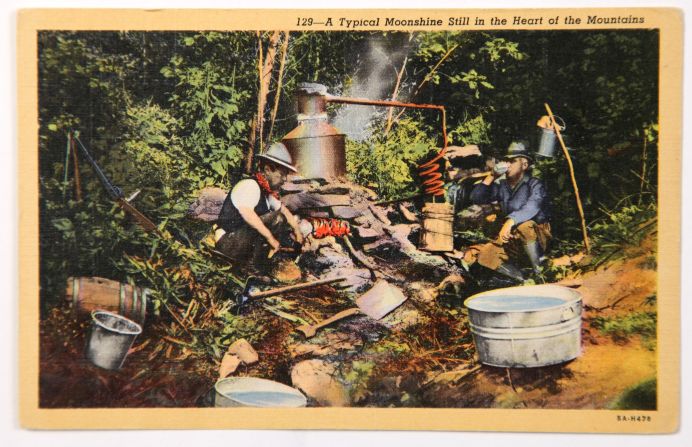
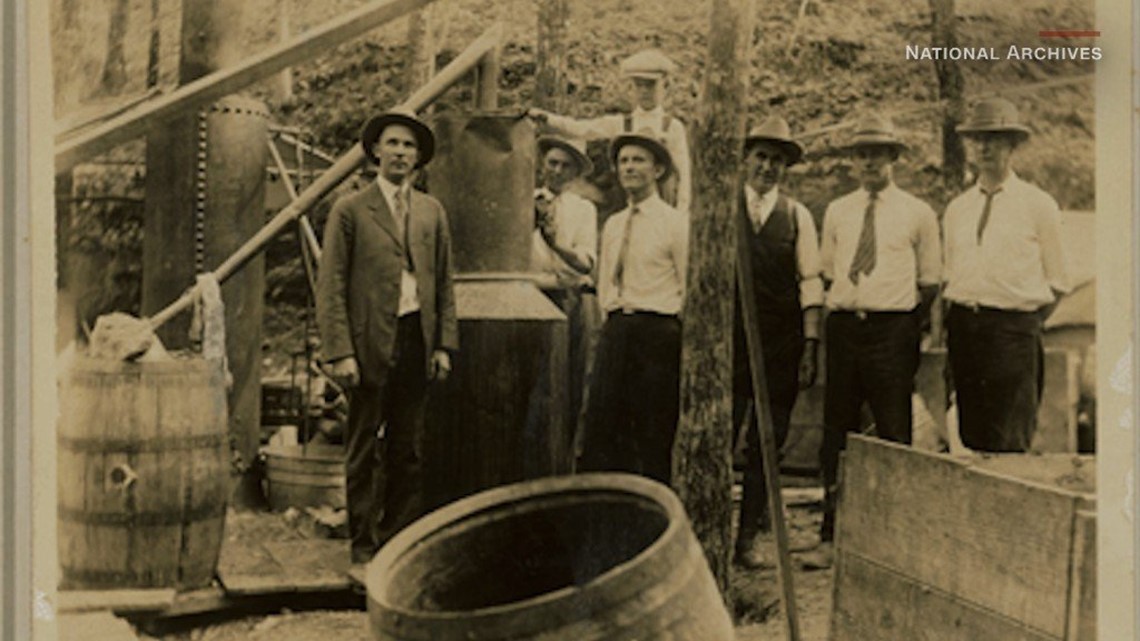
At the heart of every moonshine operation was the still itself, traditionally crafted from copper for its superior heat conduction and its natural ability to remove sulfur compounds that would otherwise make the whiskey unpalatable. A typical still consisted of several key components: the boiler (or “pot”), where the fermented mash was heated; the cap, which collected the alcohol vapors; the arm, a tube that carried the vapors away from the pot; and the worm, a coiled copper tube running through cold water that condensed the alcohol vapors back into liquid form. Some sophisticated operations utilized “thumper kegs” – secondary distillation chambers that increased both the proof and purity of the final product. Skilled coppersmiths who could craft these stills became essential figures in moonshining communities, their expertise often passed down through family lines.
The Dangerous Art of Fermentation and Distillation
Before distillation could begin, moonshiners had to prepare their “mash” – a mixture of grain, water, sugar, and yeast that would ferment to produce alcohol. The specific ingredients varied by region and availability, but corn was the predominant grain used throughout most of America. After mixing the ingredients in large wooden barrels or metal containers, the mash would ferment for several days until it reached an alcohol content of around 7-8%. The distillation process itself required careful temperature control; alcohol vaporizes at 173°F while water boils at 212°F, allowing skilled distillers to separate alcohol from the water and other components of the mash. This delicate process required experience and attention – too much heat could result in a “scorched” flavor, while improper separation could lead to dangerous methanol contamination in the final product.
Why “White Lightning” Packed Such a Punch
Traditional moonshine earned its reputation for potency honestly. Unlike commercial spirits, which were typically diluted to 40% alcohol (80 proof) before sale, moonshine often came straight from the still at proofs ranging from a reasonable 100 to a dangerous 190. This high alcohol content gave moonshine its characteristic burn and earned it colorful nicknames like “white lightning,” “stump water,” and “skull cracker.” The potency served practical purposes beyond mere intoxication – higher proof meant more value per container for bootleggers transporting the product, and consumers could dilute it themselves to make it go further.
Many moonshiners developed methods to test the proof of their product without modern equipment. One common technique was the “shake test” – shaking a jar of moonshine and observing the bubbles. If they disappeared quickly, the proof was high; if they lingered, it was lower. Another method involved pouring some moonshine on black powder – if it ignited, the proof was deemed acceptable. While crude by modern standards, these tests helped ensure consistency in an era before precise measuring tools were available to illicit distillers.
The quality of moonshine varied dramatically depending on the skill and care of its producer. Contrary to popular perception, many traditional moonshiners took immense pride in their product, developing signature recipes and techniques that became family treasures. The best moonshine was smooth despite its high proof, with distinct flavors reflecting its ingredients and the distiller’s technique. However, during Prohibition, quality often suffered as inexperienced distillers entered the trade seeking quick profits, leading to inferior and sometimes dangerous products that damaged moonshine’s reputation.
- A complete moonshine operation required not just the still but supporting equipment like fermentation vessels, cooling systems, and specialized tools
- Water quality was crucial – the best operations used natural mountain springs for both fermentation and cooling
- Most moonshiners developed their own proprietary mash recipes, varying the ratio of corn, sugar, and other ingredients
- Runs typically took 4-8 hours to complete, yielding different “cuts” of spirits with varying quality
- Only the “middle run” or “heart” was considered premium quality; the “foreshots” were toxic and the “tails” inferior
Myths and Realities About Methanol Dangers
The dangers of poorly made moonshine weren’t entirely mythical. Improperly produced spirits could contain dangerous levels of methanol (wood alcohol), which can cause blindness or death even in small quantities. This risk came not from the distillation process itself but from careless separation of the “foreshots” – the first liquid to come off the still, which contains most of the methanol. Experienced moonshiners knew to discard this portion, collecting only the “heart” of the run for consumption. The reputation for danger was exacerbated during Prohibition when unscrupulous producers used shortcuts and additives like formaldehyde or lye to increase profits, often with tragic consequences.
“My granddaddy taught me that making shine was like delivering a baby – you had to know exactly when to cut the head, save the heart, and stop before you got to the tail. That knowledge kept our customers healthy and coming back for more. Some folks weren’t so careful, and their customers paid the price.” – Fourth-generation moonshiner, Eastern Tennessee
Despite these risks, traditional moonshine made by knowledgeable distillers using proper techniques was generally safe. Many mountain communities relied on the same moonshine sources for generations without incident, developing relationships of trust with their local producers. The real danger came from mass-produced moonshine made by inexperienced or unethical operators during the Prohibition boom, when demand outstripped the supply of properly made spirits.
Modern legal moonshine has eliminated these risks through regulation and testing, ensuring that today’s consumers can experience the tradition without the historical dangers. But this safety comes with a trade-off – some aficionados argue that the character and regional distinctiveness of moonshine has been diminished in the transition to legal production, standardized to meet regulatory requirements rather than reflecting the diverse traditions that once defined America’s underground spirit.
Regional Moonshine Traditions Across America

“History of Moonshine | Ozark Moonshine …” from ozarkmoonshinefest.org and used with no modifications.
While Appalachia remains synonymous with moonshine culture, illicit distilling flourished across diverse American landscapes, each region developing distinct traditions reflected in production methods and flavor profiles. These regional variations tell a story of adaptation – of distillers working with locally available ingredients and responding to cultural preferences that evolved over generations. For instance, some regions are known for their traditional corn-based moonshine recipes that highlight the use of locally sourced corn.
The geographic isolation that protected moonshiners from law enforcement also limited the exchange of techniques between regions, allowing truly local traditions to develop and persist. From fruit-infused spirits along the coastal plains to grain-focused recipes in the agricultural heartland, America’s moonshine map was as diverse as its cultural landscape.
These regional differences weren’t merely about ingredients but extended to still design, fermentation practices, and even the cultural meaning attached to moonshine production. In some communities, moonshining represented economic survival; in others, it became a cornerstone of social life and cultural identity.
Appalachian Mountain Practices and Recipes
The Appalachian region, spanning from Pennsylvania to northern Georgia and Alabama, developed what many consider the quintessential American moonshine tradition. Here, corn predominated as the base ingredient, typically comprising 80-85% of the grain bill, with small amounts of malted barley to aid fermentation. Appalachian moonshiners often added rye for spiciness or wheat for smoothness, creating signature flavor profiles that distinguished one producer from another. “Sugar shine” – moonshine made with significant amounts of added sugar rather than relying solely on grain – became common during hard times when corn might be needed for food.
The isolated hollows of Appalachia fostered a culture where moonshining knowledge became closely guarded family property, passed from father to son or mother to daughter across generations. Many mountain families maintained distinctive recipes and techniques for generations, creating de facto “brands” recognized throughout their communities by distinctive flavors and production methods. The terrain itself shaped production, with hidden caves and remote hollows providing natural concealment for operations, and cold mountain springs offering ideal cooling water for condensing the distillate.

Southern Coastal Variants and Fruit-Infused Spirits
Along the coastal plains of the South, from the Carolinas through Georgia and into Florida, moonshining traditions took advantage of abundant local fruit. Peach brandy became a specialty in Georgia, while scuppernong and muscadine grapes were fermented and distilled throughout the Southeast. These fruit-based spirits required different approaches than grain moonshine, with careful attention to ripeness and sugar content. Coastal moonshiners also developed distinctive still designs adapted to the flatter terrain, often utilizing underground piping to conceal smoke and steam.
Louisiana’s unique cultural blend produced distinctive moonshining traditions influenced by French brandy-making techniques. “Chouchenn,” a honey-based spirit resembling mead before distillation, reflected both European influences and adaptation to local resources. Throughout the coastal South, access to sugar cane or molasses created opportunities for rum-like spirits outside the corn whiskey tradition dominant in the mountains.
Midwestern Corn Whiskey Traditions
The vast agricultural regions of the Midwest developed moonshining practices that took advantage of their grain surpluses. Illinois, Indiana, and Ohio moonshiners often worked with corn exclusively, producing a sweeter, fuller-bodied spirit than their Appalachian counterparts. The flat, open terrain of the Midwest presented different challenges for concealment, leading to innovations like operating from basement stills in remote farmhouses or hiding operations within outbuildings.
Midwestern moonshining saw a particular boom during Prohibition, with Chicago becoming a major distribution hub for illegally produced spirits. The proximity to urban markets shaped production practices, with greater emphasis on volume and efficiency to meet demand. This region also saw significant innovation in flavor additions, with everything from cinnamon and apple to maple and honey being incorporated into traditional recipes to appeal to urban consumer preferences.
The Secret Language of Moonshiners

“Moonshiners (TV Series 2011 …” from www.imdb.com and used with no modifications.
- Blockader – term for a moonshiner, referring to their blocking of tax revenues
- Brush whiskey – moonshine made in remote wooded areas
- Cornhead – a moonshiner who uses primarily corn in their mash
- Rev’nuer – government agent who enforced liquor tax laws
- Sugar head – a moonshiner who uses primarily sugar rather than grain
- Tanglefoot – moonshine strong enough to make the drinker unstable
- White mule – high-proof moonshine with a powerful kick
Moonshiners developed a rich vernacular that served both practical and cultural purposes. This specialized vocabulary allowed insiders to discuss their illegal activities in public without arousing suspicion and created a sense of shared identity among those in the trade. Terms like “singlings” (the first distillation run) and “doublings” (the second, higher-proof distillation) described technical aspects of production, while colorful phrases like “stump juice” and “popskull” captured the perceived effects of the finished product.
The language of moonshining extended beyond mere terminology to elaborate codes and signals used to warn of approaching law enforcement. Seemingly innocent phrases like “the preacher’s coming to dinner” might alert a community that revenue agents were in the area. These linguistic adaptations represent one of the most fascinating cultural developments from the moonshining tradition, demonstrating how an illegal practice could generate its own rich subculture and means of communication.
Code Words That Protected the Trade
The necessity for secrecy generated an elaborate system of euphemisms and code phrases that allowed moonshiners to conduct business without explicitly mentioning their illegal activities. Moonshine itself might be referred to as “medicine,” “the good stuff,” or simply “product,” while stills were “outfits,” “plants,” or “offices.” Financial transactions were similarly obscured, with phrases like “handling the books” referring to distribution and sales. This coded language allowed business to be conducted in plain sight, even in public settings like general stores or post offices where conversations might be overheard.
How Moonshiners Communicated About Revenuers
Warning systems about law enforcement represented the most critical communication among moonshining communities. “Revenue officers,” “government men,” or simply “the law” might be referred to as “company,” “visitors,” or “strangers” in casual conversation. A complex network of lookouts – often including children, who raised less suspicion – would use seemingly innocent signals like hanging colored laundry, positioning farm equipment in certain ways, or playing specific songs to indicate danger. During Prohibition, some communities even implemented elaborate relay systems using car horns, gunshots, or church bells to spread warnings across mountain hollows when federal agents were spotted in the area.
Women in Moonshining: The Untold Stories
“The Moonshine Women by Michelle Collins …” from www.barnesandnoble.com and used with no modifications.
The popular image of moonshining as exclusively male territory obscures the significant role women played throughout the history of illicit distilling. While rarely acknowledged in media portrayals or historical accounts, women were integral to moonshine production, distribution, and protection across generations. Their contributions ranged from active participation in distilling to critical supporting roles that kept operations running and protected them from discovery.
The erasure of women from moonshine history reflects broader patterns of gender bias in historical documentation rather than their actual absence from the practice. In many rural communities, moonshine production was truly a family business, with gender roles sometimes blurring in the face of economic necessity. Recent oral history projects and archival research have begun to recover these lost narratives, revealing the extensive involvement of women in what was previously portrayed as a masculine domain.
Female Distillers Who Ran Their Own Operations
Contrary to popular mythology, many women operated successful moonshine stills independently, particularly during periods when male family members were absent due to war, imprisonment, or death. Nancy “Courage” Redd of Kentucky became legendary in the late 19th century for the quality of her whiskey and her ability to evade authorities for decades. During Prohibition, Georgia’s Mahala Mullins operated one of the most productive moonshine operations in the Appalachians from her mountaintop home, her physical size and reputation for quality providing protection against arrest. These women weren’t anomalies but representatives of a broader tradition of female participation in what historical accounts have portrayed as a male enterprise.
How Women Protected Family Businesses During Raids
Women played crucial protective roles in moonshining communities, often using gender expectations to shield operations from law enforcement. Female family members might distract revenue agents with hospitality while men dismantled or hid equipment, or claim ignorance of operations occurring on their property. Some women became experts at concealing moonshine during raids, hiding jars under voluminous skirts or disguising spirits as household products. The presumption that women wouldn’t be involved in illegal liquor production sometimes provided perfect cover, with officers overlooking female-run operations or failing to search areas considered “women’s domains” within households.
Beyond direct protection, women maintained the social networks that supported moonshine production, sharing information about revenue officer movements and creating community solidarity against outside interference. In many communities, women’s church groups and social gatherings became important venues for exchanging coded information about potential threats to local moonshine operations, demonstrating how deeply the practice was embedded in overall community life rather than existing as a separate male activity.
From Outlaws to Artisans: Legal Moonshine Today

“legally distill our own moonshine folks …” from www.reddit.com and used with no modifications.
- Over 1,500 craft distilleries now operate legally across America
- Tennessee, Kentucky, and North Carolina lead in legal moonshine production
- Many legal producers have documented family connections to historical moonshiners
- Traditional recipes are now being adapted for commercial production
- Flavored variations like apple pie, blackberry, and cinnamon have become popular commercial products
The evolution of moonshine from outlawed substance to celebrated craft spirit represents one of the most remarkable transformations in American alcohol culture. Beginning with the repeal of Prohibition in 1933, the legal landscape for distillers gradually shifted, though significant barriers remained for small-scale producers until relatively recently. The craft distilling boom of the early 21st century has brought moonshine full circle, with descendants of illegal producers now operating licensed distilleries that celebrate rather than conceal their historical connections.
Today’s legal moonshine market spans from mass-produced commercial products to small-batch artisanal spirits that strive to preserve traditional methods. The very term that once signified illegality has been reclaimed as a marketing asset, with distilleries proudly advertising their products as “moonshine” and emphasizing connections to regional heritage and historical production methods. This transformation reflects broader changes in American attitudes toward artisanal production and cultural authenticity.
While purists might argue that “legal moonshine” is a contradiction in terms, the contemporary revival has preserved production knowledge that might otherwise have been lost as older generations of illicit distillers passed away. The documentation and standardization of traditional recipes has created a bridge between the hidden practices of the past and the transparent craft distilling movement of the present.
How Prohibition’s End Changed the Game
The repeal of Prohibition in 1933 created a complicated new reality for moonshiners. While alcohol production was no longer inherently illegal, the regulatory framework that emerged maintained significant barriers to legal production. Licensing requirements, taxation systems, and production regulations effectively excluded small-scale distillers from the legal market. As a result, moonshining continued to thrive in many rural areas, particularly in regions where economic opportunities remained limited and taxation seemed excessive relative to local incomes.
The decades following Repeal saw a gradual decline in moonshine production as economic development, increased law enforcement pressure, and changing cultural attitudes made the risks less acceptable for many potential producers. However, the tradition never disappeared entirely, with pockets of production continuing in historically active regions like Appalachia, where moonshine remained both an economic resource and a cultural practice tied to regional identity.
The Birth of Craft Distilling Laws
The legal resurrection of small-scale distilling began in the 1980s and accelerated in the early 2000s as states began revising laws to allow for craft distilleries. These regulatory changes, inspired partly by the success of the craft brewing movement, reduced licensing costs, simplified distribution requirements, and created special categories for small producers. States with strong historical connections to moonshining, such as Tennessee and North Carolina, often led the way in creating pathways for legal production that acknowledged the cultural and economic significance of local distilling traditions.
Federal regulations also evolved, with reforms to the federal distillery permitting process making small-scale commercial distilling viable for entrepreneurs without massive capital reserves. The federal small distillers tax credit, introduced in 2017, further leveled the playing field by reducing the federal excise tax for small producers. These changes collectively transformed distilling from an industry dominated by a handful of massive corporations to one where small, locally-focused operations could operate legally and profitably while maintaining connections to regional traditions.
Modern Distilleries Preserving Traditional Methods
Today’s craft distillers often straddle the line between historical authenticity and modern innovation, using traditional production methods while meeting contemporary safety and regulatory requirements. Distilleries like Popcorn Sutton’s Tennessee White Whiskey (named for legendary moonshiner Marvin “Popcorn” Sutton) and Ole Smoky Moonshine explicitly connect their products to the moonshining heritage of their regions, sometimes employing former illegal distillers as consultants or featuring equipment modeled on traditional designs. These businesses have transformed what was once a clandestine operation into a tourist attraction, with distillery tours allowing visitors to witness production methods that were hidden for generations.
Moonshine in Popular Culture: From Stereotype to Celebration

“Lucas Owens will be featured in a …” from www.gastongazette.com and used with no modifications.
The cultural representation of moonshining has undergone a remarkable transformation over the past century, evolving from criminal stereotype to celebrated heritage. Early portrayals in literature and film often depicted moonshiners as either dangerous criminals or comical hillbilly caricatures, reflecting urban America’s conflicted fascination with rural traditions. These representations rarely captured the economic necessity or cultural complexity that underpinned real moonshining communities.
The mid-20th century saw moonshining enter American popular culture through music, film, and television, often romanticized as a symbol of independence and resistance to authority. Folk songs celebrated the cat-and-mouse game between moonshiners and revenuers, while films like “Thunder Road” (1958) starring Robert Mitchum transformed bootleggers into anti-hero protagonists. These portrayals, while still simplified, began to acknowledge the skilled craftsmanship and cultural significance behind the practice.
Contemporary representations have largely shifted toward celebrating moonshine as cultural heritage rather than criminal enterprise. Television programs like “Moonshiners” blend documentary elements with dramatic storytelling, while heritage museums throughout Appalachia now include moonshine stills among their exhibits. This cultural rehabilitation parallels the legal transformation of moonshine from outlaw product to craft spirit, reflecting broader changes in American attitudes toward rural traditions and artisanal production.
- Movies: “Thunder Road” (1958), “The Last American Hero” (1973), “Lawless” (2012)
- Television: “The Dukes of Hazzard,” “Moonshiners,” “Outlaw: The Saga of Popcorn Sutton”
- Music: “Mountain Dew” (Grandpa Jones), “Copper Kettle” (Joan Baez), “White Lightning” (George Jones)
- Literature: “The Wettest County in the World” (Matt Bondurant), “Moonshine!” (Alec Wilkinson)
- Museums: Museum of Appalachia (TN), Appalachian Heritage Museum (NC), Kentucky Moonshine Experience
How Hollywood Shaped Our View of Moonshiners
Hollywood’s portrayal of moonshiners has cycled through various stereotypes that both reflected and influenced public perception. Early depictions often emphasized danger and criminality, portraying moonshiners as violent defenders of illegal enterprises. By the 1950s and 1960s, as rural-themed entertainment gained popularity, the image softened into the familiar “good ol’ boy” character – technically breaking the law but morally superior to the government agents pursuing him. These fictional representations rarely captured the diversity of actual moonshining communities, including their racial and gender composition, instead creating a predominantly white male archetype that became fixed in the public imagination. Recent productions have attempted more nuanced portrayals, acknowledging both the craftsmanship involved in traditional moonshining and its complex relationship with poverty, opportunity, and cultural identity.
Songs and Stories That Immortalized the Tradition
Music has played a particularly important role in shaping and preserving moonshine culture, with folk and country songs documenting techniques, celebrating successful evasions of law enforcement, and commemorating notable moonshiners. Songs like “White Lightning,” “Copper Kettle,” and “Mountain Dew” entered the mainstream American songbook, introducing urban audiences to romanticized versions of moonshine culture. These musical narratives often emphasized themes of resistance to authority and pride in craft that resonated beyond the specific context of illegal distilling. Contemporary artists continue to reference moonshining in their music, now often with nostalgic or heritage-focused themes that position the practice as part of a valued cultural tradition rather than ongoing criminal activity.
The Spirit Lives On: Moonshine’s Place in American Heritage
“It’s National Moonshine Day, Here’s a …” from www.wnep.com and used with no modifications.
The transformation of moonshine from outlaw commodity to celebrated cultural heritage reflects broader changes in how Americans relate to their rural past. What was once prosecuted as criminal activity is now preserved in museums, celebrated at festivals, and marketed as authentic cultural experience. This rehabilitation has allowed communities with historical connections to moonshining to reclaim and recontextualize these traditions as valuable cultural assets rather than shameful secrets. Today’s legal moonshine industry, heritage tourism initiatives, and cultural programming around traditional distilling all represent ways that formerly marginalized practices have been integrated into mainstream conceptions of American heritage. While the days of widespread illegal distilling have largely passed, the skills, stories, and cultural significance of moonshining continue to influence American craft spirits and regional identity, ensuring that this once-hidden tradition now has a visible place in the nation’s cultural landscape.
Frequently Asked Questions
The world of moonshine generates many questions about its history, production methods, legality, and cultural significance. For example, many wonder are stills illegal in the US? Below we address some of the most common inquiries about America’s most notorious spirit, separating fact from fiction and providing context for understanding this complex tradition.
Was moonshine really as dangerous as people say?
Moonshine’s reputation for danger stemmed from real risks but was exaggerated by prohibition-era propaganda. Properly made moonshine from experienced distillers was generally safe, as traditional producers took pride in their craft and depended on repeat business from their communities. The primary danger came from methanol contamination, which could occur if the distiller failed to discard the “foreshots” (first liquid from the still) containing concentrated methanol. During Prohibition, inexperienced or unscrupulous producers sometimes added dangerous substances like formaldehyde, lye, or even paint thinner to increase potency or stretch supplies, leading to genuine health hazards.
- Properly made traditional moonshine was generally no more dangerous than commercial spirits
- Methanol poisoning was the primary risk from improperly distilled spirits
- Lead poisoning could occur from poorly constructed stills using car radiators or lead solder
- Reports of moonshine dangers were often exaggerated by prohibition advocates
- Modern legal moonshine eliminates these risks through regulation and testing
Government agencies and temperance organizations had incentives to emphasize the dangers of moonshine, sometimes exaggerating or generalizing from isolated incidents. These reports rarely distinguished between traditional moonshine made by experienced distillers and adulterated products from opportunistic producers during Prohibition, creating an overly simplistic narrative about the dangers of all unregulated spirits.
Today’s legal moonshine eliminates these historical risks through regulation, testing, and standardized production methods. Licensed distilleries must meet strict safety standards and are subject to regular inspections, ensuring that commercial “moonshine” products pose no more health risk than any other regulated spirit.
What ingredients were traditionally used to make moonshine?
Traditional moonshine was primarily made from corn, reflecting both its agricultural abundance in moonshining regions and its efficiency in producing fermentable sugars. A typical mash bill might contain 80-85% corn, supplemented with small amounts of malted barley (5-10%) to provide enzymes that convert starches to sugars. Some recipes incorporated other grains like rye or wheat for distinctive flavors. Regional variations might use entirely different base ingredients, particularly in areas where fruit was plentiful.
During economic hardships or when corn supplies were needed for food, sugar became an important ingredient in “sugar shine,” with recipes using varying proportions of corn and refined sugar. Pure sugar-based moonshine required less equipment and expertise, making it popular among novice producers, though experienced distillers generally considered it inferior to grain-based spirits. Sugar shine could be produced more quickly and cheaply, but lacked the depth of flavor found in traditional corn whiskey.
Water quality played a crucial but often overlooked role in moonshine production. The best operations used pure spring water, both for mixing the mash and for cooling during condensation. The mineral content and purity of the water could significantly affect the flavor profile of the finished product, with mountain springs particularly prized for their softness and purity.
- Corn: Primary grain for most traditional recipes (80-85%)
- Malted Barley: Added to provide enzymes for fermentation (5-10%)
- Sugar: Used to boost alcohol content or as primary ingredient in “sugar shine”
- Rye or Wheat: Optional additions for flavor complexity
- Fruits: Used in regional variations, particularly peaches, apples, or berries
- Water: Critical component affecting fermentation and final flavor profile
Flavorings in traditional moonshine were relatively rare, with most moonshiners preferring to let the natural character of their distillate speak for itself. However, some producers developed signature additions like cinnamon sticks, apple slices, or peach pits that were added after distillation to create distinctive products. These flavoring traditions have been expanded in contemporary legal moonshine, with commercial products now available in dozens of flavor variations that would have been uncommon in historical production.
Is it legal to make moonshine for personal use today?
Despite evolving attitudes and the proliferation of legal commercial moonshine, home distillation remains illegal throughout the United States. Federal law prohibits the production of distilled spirits without a permit, regardless of whether the spirits are for personal consumption or sale. This contrasts with home brewing of beer and wine, which became legal for personal use at the federal level in 1978. The prohibition on home distilling stems primarily from safety concerns about fire hazards and potential methanol contamination, along with tax revenue considerations. Penalties for illegal distillation can include up to five years in prison and fines up to $10,000, though enforcement typically focuses on larger operations rather than small personal stills. For those interested in the tradition, legal options include visiting craft distilleries, purchasing commercial moonshine, or in some states, participating in guided distilling experiences under licensed supervision.
How did moonshiners avoid getting caught during Prohibition?
Moonshiners developed sophisticated evasion techniques during Prohibition, relying on geography, community support, and ingenious concealment methods. In mountainous regions, stills were hidden in remote hollows, caves, or dense forests accessible only by foot paths known to locals. Operations often maintained multiple stills across different locations, ensuring that discovery of one would not end production entirely. Smoke, a telltale sign of distillation, was mitigated through underground piping that dispersed it over wider areas or by operating only at night when smoke was less visible. Many stills were designed for quick disassembly, allowing equipment to be hidden or relocated within hours if revenuers were reported in the area. For more fascinating insights, check out moonshine’s history in North Carolina.
Perhaps the most effective protection came from community solidarity and early warning systems. Lookouts posted along access roads would signal the approach of strangers, while networks of supporters including local businesses, neighbors, and sometimes even law enforcement would provide advance warning of planned raids. This community protection reflected both economic interdependence, as moonshining supported numerous families beyond the distillers themselves, and cultural resistance to outside authority, particularly federal agents viewed as imposing distant values on local communities. The effectiveness of these protection networks explains why, despite substantial enforcement efforts, moonshining persisted throughout Prohibition and beyond in many rural areas.
What’s the difference between today’s legal “moonshine” and traditional moonshine?
Legal moonshine differs from its illicit ancestor in several key aspects, beginning with regulatory oversight. Commercial products must meet strict safety standards, ensuring consistent proof and eliminating methanol risks through proper distillation techniques and quality control testing. Production scale represents another significant difference – while traditional moonshine was typically made in small batches of 20-50 gallons, commercial operations may produce thousands of gallons weekly using industrial equipment that bears little resemblance to backwoods stills. This industrialization necessarily affects production methods, with temperature control, ingredient measuring, and cutting points (separating different portions of the distillate) now precisely controlled by instruments rather than relying on the distiller’s experience and judgment.
Flavor profiles have also evolved to meet contemporary market preferences. Traditional moonshine was valued for its purity and the natural character of its ingredients, with regional variations reflecting local grains and production methods. Modern commercial moonshine often incorporates flavoring additives to create consistent, approachable products appealing to broader audiences unfamiliar with the sometimes assertive character of traditional white whiskey. The proliferation of flavored varieties – from apple pie to blackberry to cinnamon – represents a significant departure from historical production, where such additions were relatively uncommon.
Perhaps the most fundamental difference lies in cultural context. Traditional moonshine derived much of its identity from its illicit status and opposition to government authority. The spirit represented not just a beverage but a statement of independence and self-reliance in communities that often felt marginalized by mainstream economic and political systems. Legal moonshine, while preserving some production techniques and celebrating historical connections, necessarily lacks this countercultural dimension. Today’s commercial products occupy a different cultural space – less an act of resistance than a heritage product celebrating a romanticized vision of rural tradition. This transformation from outlaw spirit to nostalgic commodity reflects broader changes in how America relates to its rural past, finding value in traditions once dismissed as backward or criminal.
The Mountain Moonshine Company invites you to explore the rich heritage of American distilling through their award-winning spirits that honor traditional methods while meeting modern standards for quality and safety.